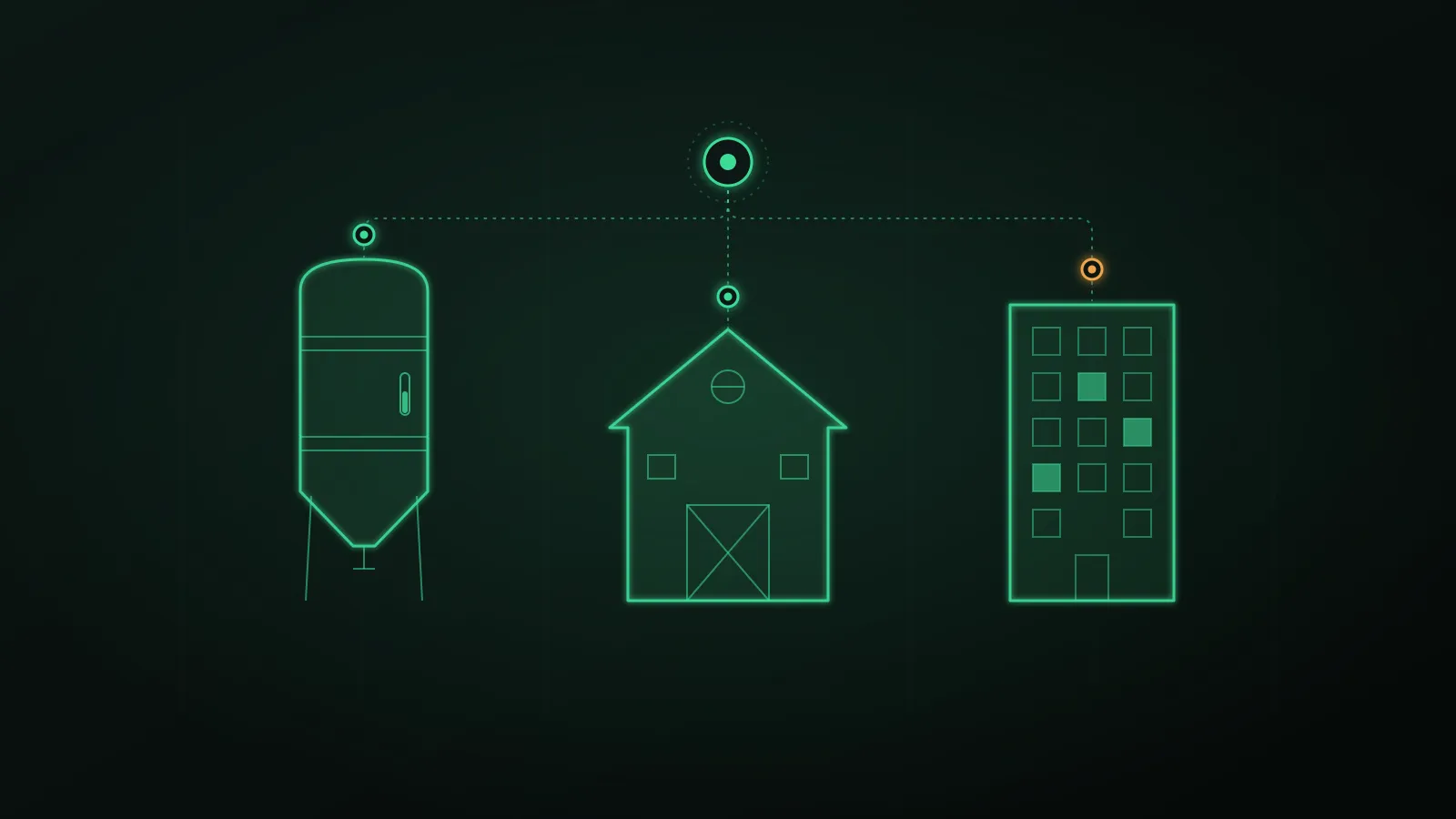
Where is Home Assistant already used in business?
In June 2019 a brewer in Singapore wrote a blog post that opens with a confession. His brewery has 15 tanks, and for years someone opened and closed the glycol valve on each one by hand, “many times a day 24×7”, to keep the beer fermenting at the right temperature. Then he rebuilt the whole thing on Home Assistant. ESPHome controllers, DS18B20 probes, solenoid valves from China that, as he dryly notes, like to get stuck in one position.
That is the short answer to the question above. Home Assistant turns up in business wherever a small operation has a very specific measuring or switching problem and the industry solution is too expensive, too rigid, or both. Breweries, barns, greenhouses, university buildings, holiday rentals.
Fifteen fermenters and a promise
Back to the brewery. The author in Singapore writes a line that stuck with me: “I will never sell my services to another brewery to set up a version of HA to be used as a control system.” He wants to share what he learned, not turn it into a business.
Six years later Greg Martin is a guest on the Home Assistant Podcast. Retired IT director, homebrewer, and according to the episode notes he has built “a system for small breweries” that monitors and controls fermentation temperatures from one place and shows gravity readings. Retrofitted Modbus PID controllers, ESPHome, Bluetooth proxies for the hydrometers. The promise from Singapore only ever bound its author, and that is just as well.
What I like about this case is that someone is carving out a niche: Home Assistant for one very particular kind of business. There is a smaller version too. In 2022 someone on the forum asks how to get the temperatures of his three fermenters out of an existing bus system and into HA. His reasoning is gloriously unbusinesslike: “Mainly because I love home assistant.” Another user promptly asks whether it is a commercial operation and brings up regulations and support. That question comes up in nearly every one of these threads.
The barn and the greenhouse
For farming there are three sources I take seriously.
The first is Farmer Ed. He got started with Home Assistant in December 2019, originally for the heating, because commercial options either didn’t fit the layout of the house or cost too much. Since then he has been documenting the automation of a small farm on GitHub: roller doors, lighting, the electric fence, water levels, weather warnings, greenhouse irrigation. On the wish list: GPS for the livestock, EID weighing scales and slurry gas sensors. This is someone building for his own farm, with no customers involved.
The second source is from the German-speaking world and is a real client project. In August 2025, a post on the HomeSmartHome forum describes how the author made the barn lighting controllable for a client with a chicken farm of several thousand birds. The farmer’s wish was modest: change a few times on his phone, set brightness and dimming speed. It was built with two DIN-rail Shelly Pro Dimmer 1PM units, HA as the interface, and Node-RED behind it writing the schedules straight into the dimmers over the API. That detail is smarter than it looks. The schedules live on the dimmer itself and don’t depend on every minute of server uptime.
Then there is Hort Assistant, which is explicitly about cost. An open collective of growers, farmers and technologists describes how to configure Home Assistant for greenhouses, high tunnels and container farms. The key claim on cost: over five or ten years it comes to “a small fraction of a comparable commercial system”. I appreciate the honest caveat that follows: large operations that need round-the-clock professional support are better served by the established commercial control systems. Nothing is for sale there, by the way. The site says so outright.
Lecture hall, office, holiday rental
At the Universidad Politécnica de Madrid, Home Assistant ran on a Raspberry Pi 4 as the “central brain” of a platform that monitors and switches the lighting in two buildings plus three air conditioning units. During the pilot in early 2020 it covered 19 switching and metering points. The authors estimate that roughly 15 percent of consumption happened during hours with no activity at all and could be avoided. A second team describes an IoT system for a smart campus that also builds on Home Assistant, alongside InfluxDB, Grafana and Node-RED. Documented in academic papers, with numbers, which makes these the most solid evidence in this collection.
Holiday rentals use HA so widely that they have integrations of their own. Rental Control reads booking calendars from Airbnb, VRBO and other platforms, generates door codes and manages them in the locks via Keymaster. This is exactly the kind of micro-business where HA feels at home.
And then there are the cases where the community pumps the brakes. In May 2025 a mechanical engineering intern asks how to move an office building with 14 rooms onto HA: air conditioning, more than twenty radiator valves, a 100 kW solar array, a gate with licence plate recognition, LoRaWAN meters. A user with five years of HA experience replies that he would find the list “daunting” and reckons on at least a year. Another writes: “HomeAssistant does not do layered security well.” Both are right, and both matter in the next section.
And the nursing home?
The best-documented case is a plan. In October 2023 a user on the official forum asks how to roll out Home Assistant across 160 rooms of a nursing home in the US. The goal is accessibility, including hooking up power wheelchairs. His requirement is sensible: one resident’s buttons and automations must never, under any circumstances, affect another resident’s room.
The replies are worth reading because they hit exactly the points that come up in any serious commercial project. HA has no role-based access control, so there is no clean way to stop resident 1 from reaching resident 482’s devices. The only clean separation would be one instance per room. Every switch has to keep working normally even when the automation fails. One user asks whether the company would survive the lights going out while someone is walking and falls, and advises talking to a lawyer and the insurer. Another puts it more bluntly: automate care for vulnerable people and someone may die. The thread doesn’t say whether the project ever went ahead.
Back in 2017, a volunteer for a non-profit supporting around 130 disabled adults in their own homes was looking for fall detection with Home Assistant. Budget: about 3,000 dollars per site. Again: ideas, suggestions, no documented outcome.
Research has more to show. A team from TU Dublin and Dundalk Institute of Technology designed and deployed a support system for people living with dementia built on Home Assistant and off-the-shelf sensors, which sends reminders and is meant to take some of the load off families. The authors talk about technical feasibility, so this is early days. The hardware is there already: 60 GHz radar modules for fall detection that feed into HA via ESPHome cost around 37 dollars, according to an overview on HomeSmartHome.
What Home Assistant is not in these settings
Home Assistant is not a medical device, not certified security equipment and not a fire alarm system. The Apache 2.0 licence permits commercial use but carries no liability. Whoever installs it at a client’s site takes on that responsibility, and the gap between legal warranty and real-world lifespan of the hardware comes on top.
That leaves me with a simple rule. Anything that has to work in an emergency belongs in equipment built and approved for the job: the nurse call system in the care home, the alarm in the barn, the smoke detectors. HA can sit alongside, measuring, analysing, making life easier. How to wire even the basic functions so they survive a server outage is something I covered in the post on moving switching logic out of the server. The chicken farm with its schedules on the dimmer is a good example.
Then there’s the pace. Home Assistant ships a new release every month, and breaking changes come with the territory. One of the people replying in the nursing home thread concludes that HA isn’t production-ready. I’m less harsh about it, but only on one condition: someone has to look after it, regularly and in a way you can prove.
Why it rarely stops at one instance
All the cases above share something that is easy to miss. It rarely stays at one system. According to one reply on the forum, the nursing home would have needed 160 instances, one per room. In the 2025 hotel thread a user points out that hundreds of separate instances turn into an administrative problem.
That is precisely where HA Fleet Manager comes in, and I want to be exact about what that means. Each instance gets a small integration that talks to the platform over an outbound connection, with no port forwarding and no VPN. The dashboard shows which systems are online, what their connection history looks like, which critical errors are in the logs and where updates are waiting that you can trigger remotely. Remote access only opens once the operator on site approves it, and only for a limited window. I’ve argued in more detail why separate instances under one roof beat one big one in the post on multi-tenant for service providers. What the process looks like in practice is on the home page.
What it isn’t: an alarm system. If the ventilation in a barn fails, HA Fleet Manager is not what you should be counting on to keep the animals alive. It tells you an instance has stopped reporting. It doesn’t phone anyone to run out to the barn.
The brewer in Singapore, incidentally, ended his post with a list of thank-yous, from Paulus Schoutsen to Otto Winter, and promised everyone on it a beer if they ever made it to Singapore. Whether anyone collected isn’t recorded anywhere. That’s one open question I can live with.